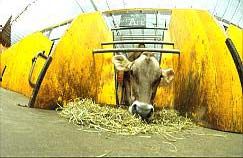
In a feeding trial with dairy cows, the nutritional value (especially the protein effect) of these feedstuffs is tested in comparison to the protein carriers soybean meal and rapeseed cake.
In the production of alcohol from grain, so-called stillage is produced as a byproduct. In this process, starch is converted into sugar, which is then fermented into alcohol by yeast. This enriches the other nutrients of the grain. Furthermore, the multiplication of the yeast cells leads to the formation of new proteins (MENKE & HUSS 1987).
Table 1 lists the nutrient contents of several cereal grains, the distillates produced from them, and the protein feeds soybean meal and rapeseed cake for comparison (DLG 1997). Alcohol production reduces the starch content of the grain raw material from 60–70% to below 10%, while all other nutrients increase (crude protein from 12% to 31%, crude fat from 3% to 7%, crude fiber from 3.6% to 10.9%). This loss of starch is associated with a decrease in digestibility (from 87% to 73%) and energy concentration (from 8.4% to 7.1 MJ NEL). The protein and energy content of typical protein feeds such as soybean meal and rapeseed cake is higher.
Analyses of "Starprot Wheat" and "Starprot Maize" (conducted at the Rosenau feed laboratory of the Lower Austrian Chamber of Agriculture and the feed laboratory of the LKS in Lichtenwalde, Saxony) show a high degree of agreement with the values in the DLG table (DLG 1997). However, according to the analysis by the LKS feed laboratory in Lichtenwalde, a significantly higher unaffected protein (UDP) is assumed. Therefore, in a feeding trial with dairy cows, the nutritional value (especially the protein effect) of these feeds will be tested in comparison to the protein sources soybean meal and rapeseed cake.
Table 1: Nutrient content of concentrate feed components (in dry matter)
(DLG 1997)
|
XP |
XL |
XF |
XX |
XA |
XS |
dOM |
ME |
NEL |
UDP |
nXP |
RNB |
|
|
G |
G |
G |
G |
G |
G |
% |
MJ |
MJ |
% |
G |
G |
|
|
barley |
119 |
23 |
52 |
779 |
27 |
604 |
87 |
12,93 |
8,16 |
25 |
165 |
-7 |
|
Wheat |
138 |
20 |
29 |
794 |
19 |
662 |
89 |
13,37 |
8,51 |
20 |
172 |
-5 |
|
corn |
106 |
45 |
26 |
806 |
17 |
694 |
86 |
13,29 |
8,39 |
50 |
164 |
-9 |
|
Barley distillers |
283 |
68 |
126 |
467 |
56 |
50 |
67 |
10,94 |
6,49 |
40 |
206 |
+12 |
|
Wheat distillers |
362 |
67 |
97 |
416 |
58 |
33 |
- |
- |
- |
- |
- |
- |
|
Starport wheat1) |
360 |
30 |
70 |
490 |
50 |
20 |
80,6 |
12,10 |
7,40 |
60 |
317 |
+6,8 |
|
Maize distillers |
297 |
82 |
104 |
466 |
51 |
92 |
79 |
12,68 |
7,75 |
50 |
242 |
+9 |
|
Starport Corn1) |
290 |
130 |
67 |
461 |
52 |
58 |
89,2 |
13,60 |
8,40 |
70 |
306 |
-2,6 |
|
Soybean meal 44 |
510 |
15 |
67 |
341 |
67 |
69 |
91 |
13,75 |
8,63 |
35 |
308 |
+32 |
|
Rapeseed cake |
370 |
101 |
128 |
326 |
75 |
0 |
80 |
13,06 |
7,99 |
30 |
217 |
+25 |
1) Company information (STHG - STARREIN, Weitersfeld, Lower Austria)
Experimental procedure:
The experiment is conducted using the Latin square method with 15 animals (3 × 3) in 3 periods. Each period lasts 4 weeks.
Feed ration:
The basic feed consists of 50% grass silage (second cut), 20% hay (first cut), and 30% corn silage (dry matter base). A potential milk yield of 14 kg from the basic feed is assumed. For every kg of milk yield above this, 0.5 kg of concentrate is administered (milk matter base).
The concentrated feed consists of energy sources (90% barley, 10% wheat bran) and protein sources. The protein feedstuffs represent the research question:
Rapeseed/Soybean: 60% rapeseed cake, 35% soybean meal, 5% vegetable fat (control group)
Starprot Wheat: 90% Starprot Wheat, 10% Vegetable Fat
Starprot corn: 100% Starprot corn
Rapeseed cake and vegetable fat are used to balance the high fat content of Starprot maize. The proportions of the experimental feed mixtures and their nutrient content are listed in Table 2. The feed mixtures should have the same content of nXP, NEL, and crude fat (180 g nXP, 4.3% XL, 8.0 MJ NEL).
Table 2: Composition (% FM) and nutrient content of the experimental concentrates (in DM)
|
composition |
Rapeseed/Soybean |
Starport wheat |
Starport Corn |
|
|
barley |
% |
72,0 |
74,3 |
74,7 |
|
Wheat bran |
% |
8,0 |
8,3 |
8,3 |
|
Rapeseed cake |
% |
12,0 |
- |
- |
|
Soybean extraction meal 44 |
% |
7,0 |
- |
- |
|
Starport wheat |
% |
- |
15,8 |
- |
|
Starport Corn |
% |
- |
- |
17,0 |
|
vegetable fat |
% |
1,0 |
1,8 |
- |
|
Nutrient content |
||||
|
XP |
G |
179 |
158 |
151 |
|
XL |
G |
43 |
43 |
43 |
|
XF |
G |
68 |
61 |
61 |
|
XX |
G |
672 |
705 |
710 |
|
XA |
G |
38 |
33 |
34 |
|
NEL |
MJ |
8,07 |
8,00 |
8,01 |
|
nXP |
G |
181 |
181 |
180 |
|
UDP |
% XP |
28,2 |
37,5 |
39,6 |
|
RNB |
G |
-0,4 |
-3,5 |
-4,5 |
The animals receive 100 g of mineral mixture and 40 g of livestock salt daily. Basic feed is offered ad libitum (5 to 7% back feed).
Surveys:
Live weight: once per week
Milk yield: Daily (quantity and composition)
Food intake: in the 4th week of the experiment of a period
BCS: twice per period
Feed analysis: Composite sample per period (Weender analysis, structural substances, minerals and trace elements, cellulase)