

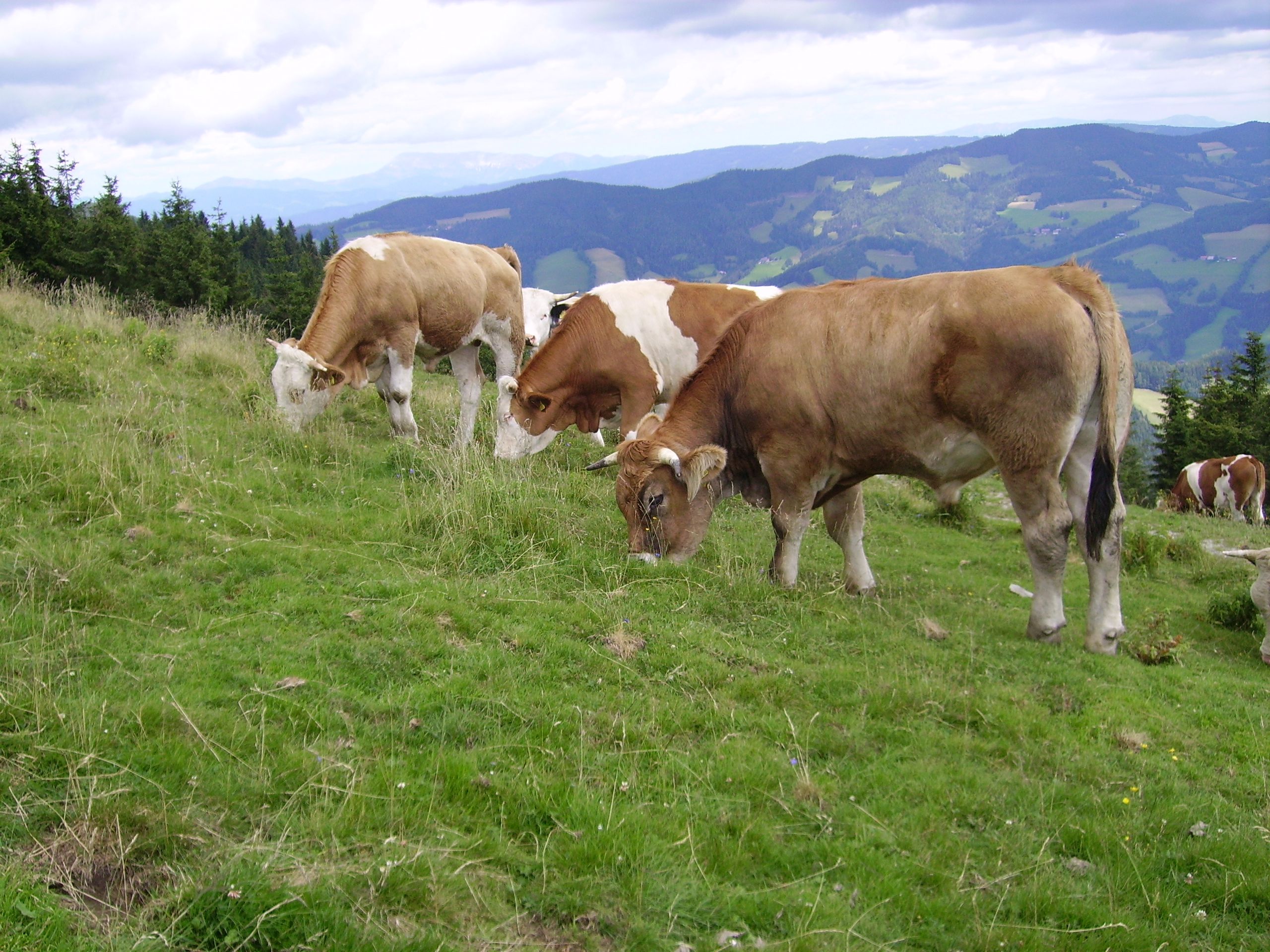
Three extensive production methods with different ruminants were investigated (sheep farming and lamb production, suckler cow husbandry and heifer rearing, and ox fattening). All variants were evaluated both with and without alpine grazing. Existing results from organic milk production were used as baseline data, as it represents the most intensive form of ruminant husbandry in extensive agriculture. A comparison with intensive livestock farming or arable farming was not conducted, as these farming methods are not feasible in mountainous regions.
The alpine grazing period itself is largely unaffected by direct and indirect emissions; even greenhouse gas emissions can be considered neutral in the long term. In all cases, alpine grazing results in lower environmental impacts. The greatest influence on the results comes from the purchase of animals in specialized steer fattening and the lower production efficiency in lamb production. Suckler cow husbandry fares favorably.
In summary, the animals' yields during the alpine grazing season are offset by virtually no emissions. Extensive use of alpine pastures is the best way to contribute to sustainability in ruminant husbandry. Nevertheless, the art of farm management lies in organizing the optimal use of resources for one's own specific location.
Impact of alpine pasture management on environmental effects per hectare
|
Environmental impacts per hectare (land management) |
|||||||
|
Environmental impact |
Unit |
Value |
Standardization |
||||
|
Extensive cattle farming |
dairy cattle |
Extensive cattle farming |
dairy cattle |
||||
|
with alpine pasture |
without alpine pasture |
with alpine pasture |
without alpine pasture |
||||
|
Non-renewable energy |
MJ |
10.474 |
15.239 |
19.623 |
0,5 |
0,8 |
1 |
|
Global warming potential (GWP) 100 |
kgCO2e |
3.921 |
5.591 |
7.323 |
0,5 |
0,8 |
1 |
|
Potential nitrogen losses |
kg N |
13,73 |
17,66 |
19,54 |
0,7 |
0,9 |
1 |
|
Potential phosphorus losses |
kg P |
0,42 |
0,54 |
0,56 |
0,7 |
1,0 |
1 |
|
Heavy metals in the soil |
kg 1.4-DBe |
1,32 |
1,60 |
1,34 |
1,0 |
1,2 |
1 |
Impact of alpine pasture management on environmental effects per 100 MJ VE
|
Environmental impacts per 100 MJ VE (food requirement) |
|||||||
|
Environmental impact |
Unit |
Value |
Standardization |
||||
|
Extensive cattle farming |
dairy cattle |
Extensive cattle farming |
dairy cattle |
||||
|
with alpine pasture |
without alpine pasture |
with alpine pasture |
without alpine pasture |
||||
|
Non-renewable energy |
MJ |
730 |
868 |
190 |
3,8 |
4,6 |
1 |
|
Global warming potential (GWP) 100 |
kgCO2e |
271 |
312 |
71 |
3,8 |
4,4 |
1 |
|
Potential nitrogen losses |
kg N |
0,96 |
1,02 |
0,17 |
5,5 |
5,8 |
1 |
|
Potential phosphorus losses |
kg P |
0,028 |
0,030 |
0,006 |
4,9 |
5,3 |
1 |
|
Heavy metals in the soil |
kg 1.4-DBe |
0,094 |
0,099 |
0,014 |
6,9 |
7,3 |
1 |
Impact of alpine pasture management on environmental effects per kg of protein
|
Environmental impact per kg of dietary protein (nutritional requirement) |
|||||||
|
Environmental impact |
Unit |
Value |
Standardization |
||||
|
Extensive cattle farming |
dairy cattle |
Extensive cattle farming |
dairy cattle |
||||
|
with alpine pasture |
without alpine pasture |
with alpine pasture |
without alpine pasture |
||||
|
Non-renewable energy |
MJ |
316 |
376 |
119 |
2,7 |
3,2 |
1 |
|
Global warming potential (GWP) 100 |
kgCO2e |
117 |
135 |
44 |
2,7 |
3,1 |
1 |
|
Potential nitrogen losses |
kg N |
0,42 |
0,44 |
0,11 |
3,8 |
4,0 |
1 |
|
Potential phosphorus losses |
kg P |
0,012 |
0,013 |
0,004 |
3,4 |
3,7 |
1 |
|
Heavy metals in the soil |
kg 1.4-DBe |
0,041 |
0,043 |
0,009 |
4,8 |
5,0 |
1 |